
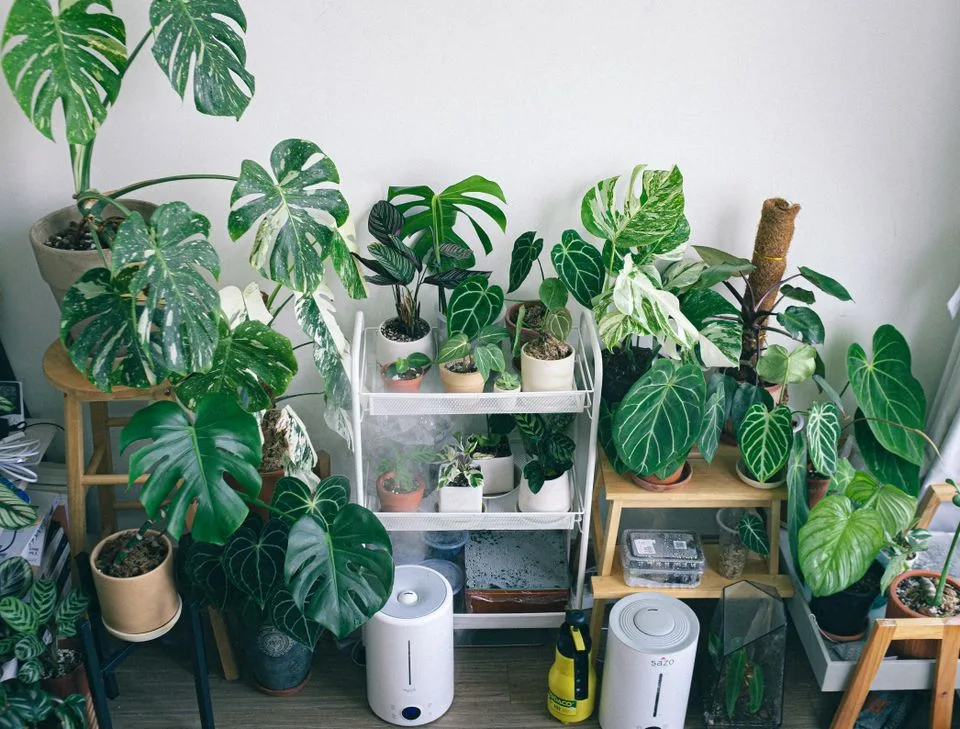
Not every houseplant needs tropical humidity. Many do well in ordinary indoor conditions, while some foliage plants struggle in dry air near heating. The photo shows a real plant collection with humidifiers; it illustrates one setup, not a required device for every plant.
Check the plant before changing the room
Identify the species and look up its growing conditions. The Royal Horticultural Society notes that plants differ in humidity needs. Brown tips or curling edges can make dry air worth investigating, but those symptoms can also reflect watering problems, fertilizer salts, or a draft. Compare affected plants in the same room and note whether a heater or air conditioner blows on them.
Check the potting mix and drainage separately. Adding moisture to the air does not correct a pot whose roots are standing in water. Maryland Extension's watering guide recommends using the plant and its mix to decide when to water, not a fixed calendar.
Ways to improve the air around a plant
Group plants with similar light and care needs so moisture released by their foliage benefits nearby plants. A room humidifier can raise humidity over a wider area; maintain it according to its manufacturer's cleaning instructions and avoid damp walls or surfaces. Keep leaves away from hot vents and cold drafts. Maryland Extension suggests grouping plants, pebble trays, and humidifiers as options.
For a pebble tray, keep the pot above the waterline rather than letting its base stand in water. A tray may help locally, but do not assume it makes an entire room humid. If you use a humidity meter, place it near the plants and watch the trend rather than chasing one perfect number for every species.
Does misting solve dry air?
Maryland Extension questions whether misting meaningfully raises humidity for long. It also cautions against wetting fuzzy leaves such as African violets. If you choose to mist a suitable plant, do it early enough for foliage to dry and do not treat it as a substitute for proper watering or a persistent humidity problem.
Review new growth after adjusting conditions. An old brown tip will remain brown. If new damage keeps appearing despite suitable humidity, use the brown tip guide to check other causes. A photograph cannot measure the air around a plant or tell you whether its roots are healthy.