
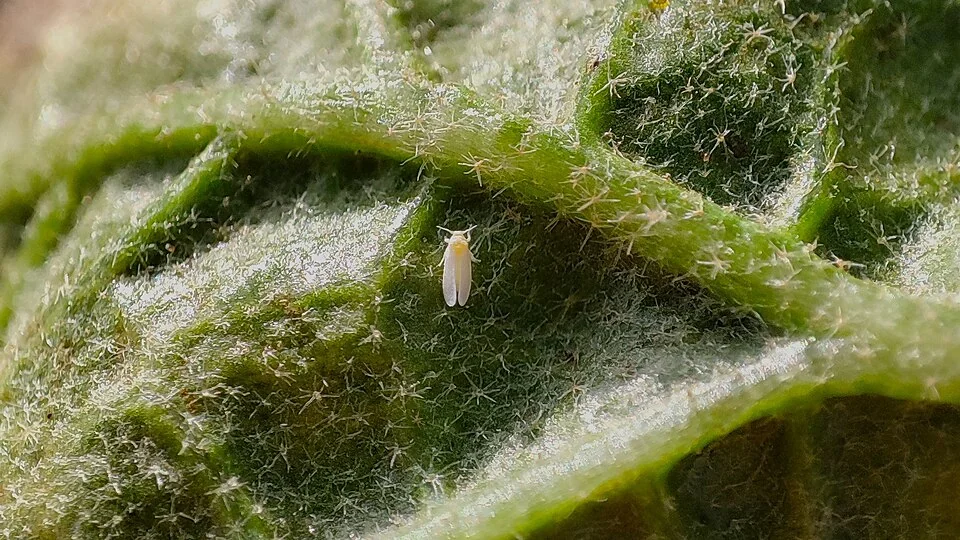
Brush a leaf and a cloud of tiny white insects rises. That is a useful clue, but look under the leaves before calling them whiteflies. The photograph shows an adult whitefly on an outdoor eggplant leaf; the same kind of close inspection helps with indoor plants.
What should you look for?
Maryland Extension describes adults as tiny, white, moth-like insects that flutter when a plant is disturbed. Their immature stages sit on leaf undersides as small, flat disks. Check several leaves, especially newer growth, with a bright light. A sticky coating can be honeydew left by feeding whiteflies; a black coating may be sooty mold growing on it.
Do not identify every small flying insect as a whitefly. Fungus gnats are dark and often appear near damp potting mix. White specks that stay attached may instead be mealybugs or another pest. A still photograph of a single speck cannot show the characteristic fluttering or confirm the immature stages.
What can you do first?
Move an affected plant away from neighboring plants while you inspect it. Check nearby foliage too, including leaf undersides. Minnesota Extension recommends early detection, washing plants, and using sticky cards to monitor flying pests. A card can show whether adults remain, but it does not remove the young attached beneath leaves.
For a small infestation, gently rinse or wipe accessible leaves, supporting delicate foliage. Repeat inspections because new adults may emerge after the first cleaning. Remove badly infested leaves only if the plant can spare them. Keep the plant's usual light and watering appropriate; pest control does not fix a stressed root system.
When is a spray useful?
If whiteflies persist, Maryland Extension suggests an insecticidal soap labeled for the plant and pest, directed at leaf undersides. Follow the product label and test sensitive foliage first. Do not substitute household dish detergent, which can injure leaves. Recheck the plant over time rather than assuming one application reaches every stage.
If many plants are involved or the plant is declining despite treatment, ask a local extension plant clinic to identify a specimen. The right next step depends on what is actually feeding on the leaves.